 ACESSIBILIDADE
 LIBRAS





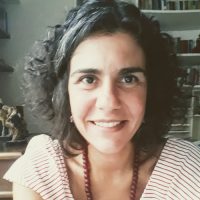
Adriana Carvalho Lopes
Permanente
Lattes: http://lattes.cnpq.br/5893523453985948
Associate Professor at the Federal Rural University of Rio de Janeiro (UFRRJ). Teaches undergraduate courses in Literature and Pedagogy at the Multidisciplinary Institute (IM) and participates in the Graduate Program in Education (PPGEDUC) under the research line Line 3 – Ethnic-Racial and Gender Education: Languages and Afro-Diasporic Studies. Also serves as a collaborating professor in the Interdisciplinary Graduate Program in Applied Linguistics (PIPGLA), under the research line Line 1 – Discourse and Literacies.
Previously served as a professor at the Federal University of Tocantins (UFT) from 2003 to 2009. Holds a Bachelor’s degree in Literature from the University of Brasília (2000), a Master’s degree in Linguistics from the University of Brasília (2003), and a Ph.D. in Linguistics from the Institute of Language Studies at the State University of Campinas (IEL/UNICAMP, 2010).
In 2008, she was a visiting researcher in the Department of African American Studies at the University of California, Berkeley, supported by a CAPES scholarship. She leads the Contemporary Literacies Studies Collective (CELeC). Her research interests include youth studies, literacies, and ethnic-racial and gender relations from interdisciplinary perspectives that connect Applied Linguistics, Anthropology, and Education. She has extensive experience in training Portuguese language teachers, integrating linguistic, social, and human development. Between 2010 and 2012, she was on maternity leave.
CONTACT INFORMATION
E-mail: adrianaclopes@ufrrj.br
RESEARCH LINE
- Line 3: Ethnic-Racial and Gender Education: Languages and Afro-Diasporic Studies
RESEARCH GROUP
- Contemporary Literacies Studies Collective (CELeC)
Coordinator: Adriana Carvalho Lopes
The Contemporary Literacies Studies Collective (CELeC) is an interdisciplinary research group that trains students and researchers in education and applied linguistics, across undergraduate and graduate (Master’s and Ph.D.) levels. With two research lines, the group critically examines contemporary literacies and linguistic performances that circulate inside and outside school institutions, aiming to build linguistic education committed to human plurality and anti-racist, anti-sexist, and anti-homophobic struggles.
Facebook: https://www.facebook.com/celec.pesquisas.7
Instagram: https://www.instagram.com/celecpesquisas/
YouTube: https://www.youtube.com/channel/UCSard6vh8XSJrKJq2WqX-lg
RESEARCH PROJECTS
- What do youths learn outside of school? Literacy practices in peripheral cultural interventions
Period: 2016 – Present
This research is part of the “Non-School Literacies” research line within the Contemporary Literacies Studies Collective (CELeC). It aims to investigate the literacy practices of youths in Baixada Fluminense, a metropolitan region in Rio de Janeiro historically stigmatized as a land of coronelismo, banditry, violence, and poverty. Despite these narratives, the region is a culturally rich and vibrant territory, hosting funk circles, rap battles, poetry salons, and film clubs.
This research approaches these cultural productions not only as political interventions in their territories but as “literacy agencies”—spaces where youth engage in reading and writing practices for shared goals. The broader aim is to understand how these practices are used, signified, and disseminated by young people.
The study also seeks to construct pedagogies that are sensitive to how students mobilize specific symbolic and material resources within their communities—resources often overlooked by traditional school literacies. Grounded in the principles of the “New Literacy Studies” (as proposed by Brian Street) and the interdisciplinary framework of Moita Lopes, the research uses ethnographic and linguistic interpretation of literacy practices in cultural interventions occurring in Nova Iguaçu, RJ.
Research Group: Contemporary Literacies Studies Collective (CELeC)
Funding: National Council for Scientific and Technological Development (CNPq) / FAPERJ
Keywords: Literacies; Ethnic-Racial Relations; Gender; Territory
 adrianaclopes@ufrrj.br
 http://lattes.cnpq.br/5893523453985948


