 ACESSIBILIDADE
 LIBRAS



Visita de professores da Universidade de Clemson
Postado em 6 de fevereiro de 2023
No dia 31/01/2023, recebemos os professores Ryann Cartor e Rafael Gregório, ambos da School of Mathematical and Statistical Sciences, da Universidade de Clemson, Carolina do Sul, Estados Unidos. Ambos apresentaram os seus trabalhos no auditório da Biblioteca Central da UFRRJ.
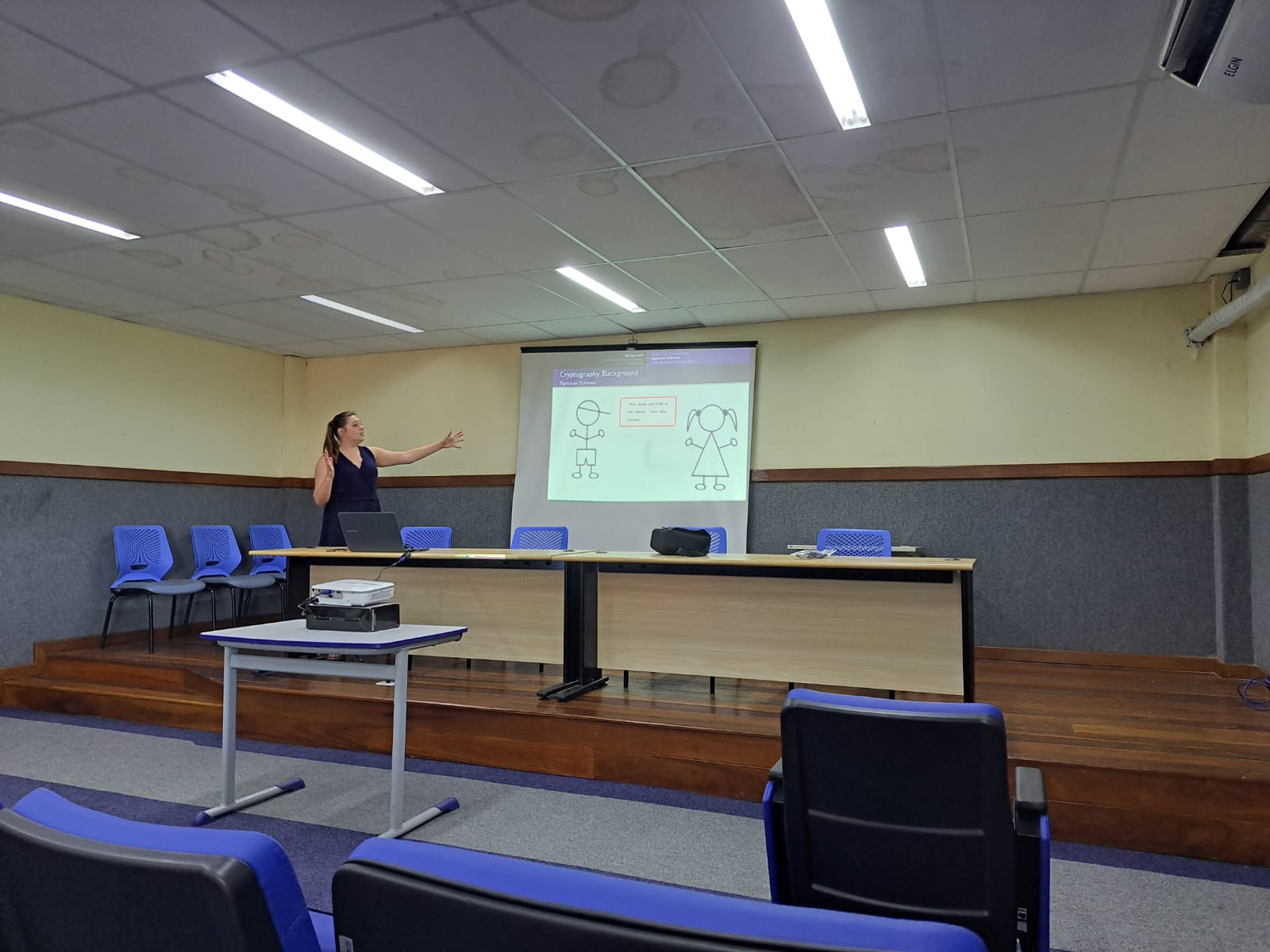
Professora Ryann Cartor Ryann Cartor | Mathematical and Statistical Sciences Profile (clemson.edu)
Abstract: The Rainbow signature scheme is the only multivariate scheme listed as a finalist in round 3 of the NIST post-quantum standardization process. A few recent attacks, including the intersection attack, rectangular MinRank attacks, and the “simple attack,” have changed this landscape; leaving questions about the viability of this scheme for future application. In this talk, we will introduce signature schemes in general and the Rainbow and IPRainbow crypto systems. We analyze the possibility of repairing Rainbow by adding an internal perturbation modifier and to compare its performance with that of UOV at the same security level. While the costly internal perturbation modifier was originally designed with encryption in mind, the use of schemes with performance characteristics similar to Rainbow is most interesting for applications in which short signatures or fast verification is a necessity, while signing can be done offline. We find that Rainbow can be made secure while achieving smaller keys, shorter signatures and faster verification times than UOV, but this advantage comes at significant cost in terms of signing time.
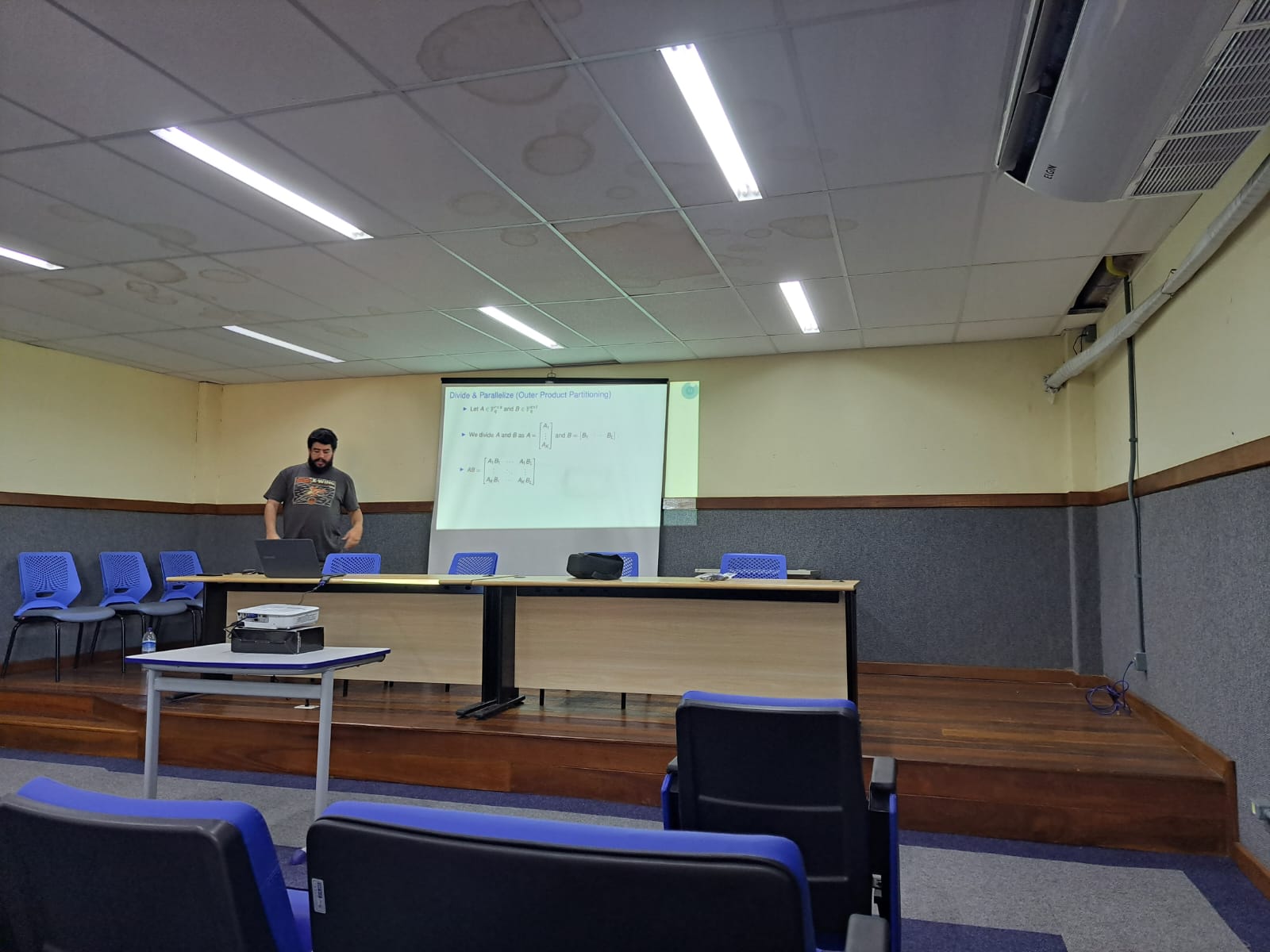
Professor Rafael Gregório Rafael Gregorio Lucas D’Oliveira | Mathematical and Statistical Sciences Profile (clemson.edu)
Abstract: Matrix multiplication is, oftentimes, the most expensive computational task in many practical algorithms. It is the computational bottleneck for training many of the now well-celebrated learning algorithms, for example. To speed up an algorithm, the data can be distributed on many machines to perform the computations in parallel. This sharing of the data, however, raises security concerns when the data is sensitive and has to remain private, such as financial or medical data. Secure distributed matrix multiplication (SDMM) studies how to parallelize matrix multiplication while keeping the data secure. In this talk, we present a combinatorial tool, called the degree table, and show how to utilize it to construct codes for SDMM which are currently the best performing for their parameters. I will also show lower bounds for this technique and characterize the total time complexity for SDMM codes, showing that if the parameters of the code are not chosen carefully, the total time might be larger than simply performing the computation locally.